Registrations Needed to Start a Business in India (2026): Udyam, GST, Shop Act & More

- 1. Udyam (MSME) Registration — get it first
- 2. Shop & Establishment Registration (Shop Act / Gumasta)
- 3. GST Registration — only when you need it
- 4. FSSAI Food Licence — for any food business
- 5. Professional Tax (state-wise)
- 6. Trademark — protect your brand name
- 7. Other registrations you may need later
- What a typical small business needs
- Do it the smart way
- Frequently Asked Questions
You have a business idea, maybe even your first customers — and now everyone is telling you to "get registered". But which registrations does a small business in India actually need? Many owners either pay for registrations they don't need yet, or skip one that later blocks a bank account, a loan or a big client.
This guide explains every common registration in simple language — what it is, whether it is compulsory for you, the cost and the documents — so you can do the right ones in the right order.
Quick answer: Almost every small business should get Udyam (MSME) registration (free, one day) and the shop/establishment registration of its state. GST is compulsory only above the turnover limit or for certain businesses like online sellers. Food businesses also need FSSAI. Trademark, Professional Tax and IEC depend on your business.
1. Udyam (MSME) Registration — get it first
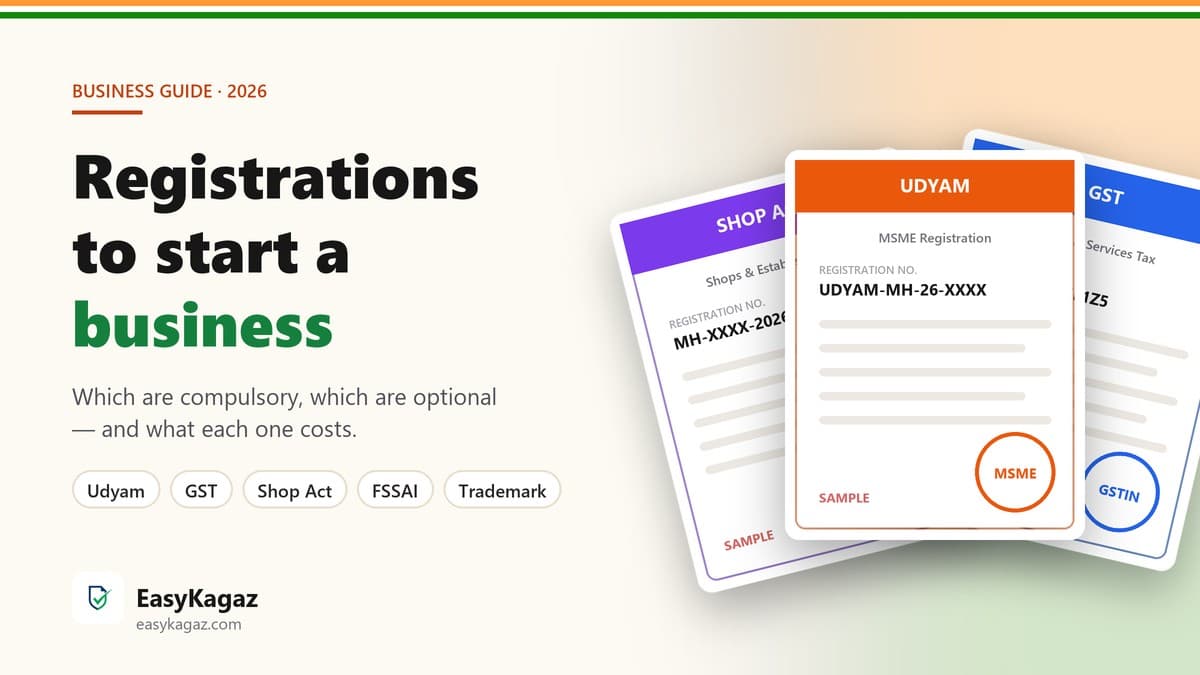
Udyam Registration is the government's official MSME identity for your business. It is issued by the Ministry of MSME on udyamregistration.gov.in and gives you a certificate with a number like UDYAM-MH-26-0000000.
- Compulsory? Not by law, but it is the cheapest and most useful registration for a small business.
- Government fee: Free.
- Time: Usually the same day or within 1–3 days.
- Documents: Owner's Aadhaar (with linked mobile), PAN, bank details, business address and activity.
Why it matters: banks accept it as business proof for a current account, it helps with collateral-free loans and interest subsidies, protects you against delayed payments from buyers (45-day payment rule for MSMEs), and gives priority in government tenders.
👉 Get it done for you: Udyam Registration
2. Shop & Establishment Registration (Shop Act / Gumasta)
Every state has a Shops and Establishments Act. It covers shops, offices, clinics, salons, coaching classes, restaurants and most commercial places.
- Compulsory? Yes — almost every commercial establishment must either register or file an intimation under its state's law.
- In Maharashtra: small establishments file a free online intimation of commencement (often called the Shop Act or Gumasta certificate) on the Aaple Sarkar / Labour Department portal. Rules for larger establishments were revised in 2025–26 and some now register under the OSH Code instead — check the current rule for your number of workers.
- Other states: registration fees and forms differ; most states have an online portal.
- Documents: Owner's Aadhaar and PAN, photo, shop/office address proof (electricity bill or rent agreement), photo of the shop with the name board.
Why it matters: banks usually ask for it to open a current account in the business name, and it is proof that your premises are legally operating.
3. GST Registration — only when you need it
GST registration gives your business a 15-character GSTIN so you can collect GST from customers and claim input tax credit.
GST is compulsory when:
-
Your yearly turnover crosses ₹40 lakh for goods or ₹20 lakh for services (lower limits — ₹20 lakh / ₹10 lakh — apply in some special category states).
-
You sell online through marketplaces like Amazon or Flipkart.
-
You make inter-state sales of goods.
-
You are a casual taxable person, an input service distributor, or fall in other notified categories.
-
Government fee: Free on the GST portal.
-
Time: Usually 3–7 working days if documents are in order.
-
Documents: PAN, Aadhaar, photo, business address proof, bank proof (cancelled cheque or passbook), and rent agreement/NOC if the premises are rented.
Don't register too early without a reason — once registered, you must file returns every month or quarter even if there is no sale. But do register if your big clients only deal with GST-registered vendors, because they want the input credit.
4. FSSAI Food Licence — for any food business
If you make, sell, store, pack or serve food — restaurant, cloud kitchen, sweet shop, tiffin service, kirana with loose food items, home bakery — you need FSSAI.
- Basic registration: turnover up to ₹12 lakh a year.
- State licence: larger businesses within one state.
- Central licence: very large businesses, importers and some specific categories.
- Documents: Photo ID, address proof of the premises, list of food products, and for licences a layout plan and water test report.
5. Professional Tax (state-wise)
Some states — including Maharashtra, Karnataka, West Bengal, Gujarat and Telangana — charge Professional Tax. In Maharashtra, a business owner usually needs a PTEC (for the business/owner) and, once you have salaried employees, a PTRC to deduct and pay their professional tax.
6. Trademark — protect your brand name
A trademark is optional, but if you are spending money on a shop name, logo or packaging, filing a trademark early stops others from copying it. You can use the ™ symbol as soon as you file; ® is allowed only after registration. Government fees are lower for individuals, startups and MSMEs (another reason to get Udyam first).
7. Other registrations you may need later
- Import Export Code (IEC): only if you import or export.
- Trade licence: some municipal corporations require one for certain trades.
- Current bank account: not a registration, but you need Udyam/Shop Act/GST as business proof to open one.
- PF and ESIC: once you cross the employee limits under labour laws.
What a typical small business needs
- Salon, tuition, clinic, service business: Udyam + Shop Act. GST only after crossing ₹20 lakh, or if clients demand it.
- Kirana or retail shop: Udyam + Shop Act + FSSAI if you sell food items. GST after ₹40 lakh (goods).
- Restaurant / cloud kitchen: Udyam + Shop Act + FSSAI + GST (food delivery apps usually require GST).
- Online seller: Udyam + GST from day one + Shop Act for your office/warehouse.
- Freelancer / consultant: Udyam + GST once billing crosses ₹20 lakh.
Do it the smart way
The registrations above are free or cheap on government portals — the real cost is your time, rejected applications and running between offices. If you also want to get found on Google, take a look at our business website + registration packages: Udyam, GST and Shop Act filed for you, plus a professional website on your own domain, with one project manager.
Frequently Asked Questions
Q: Which registration should a new business do first?
A: Start with Udyam (MSME) registration — it is free, quick and works as business proof. Then do your state's Shop & Establishment registration or intimation, and GST/FSSAI if they apply to you.
Q: Is GST registration compulsory for a small shop?
A: No, not until your yearly turnover crosses ₹40 lakh for goods or ₹20 lakh for services (lower in some special category states), unless you sell online through marketplaces or make inter-state sales of goods.
Q: Is Udyam registration compulsory?
A: It is not compulsory by law, but it is free and gives MSME benefits like easier loans, interest subsidies and protection against delayed payments, so almost every small business should get it.
Q: Can I open a current account without GST?
A: Yes. Banks generally accept Udyam certificate, Shop Act registration or other business proof for a proprietorship current account. Requirements vary by bank.
Q: Do home businesses need Shop Act registration?
A: It depends on the state and the type of work. Purely home-based work with no commercial premises is often outside the Shops Act, but home food businesses still need FSSAI. Check your state's rules.
Q: How much does it cost to register a small business in India?
A: Udyam and GST are free on government portals, Shop Act and FSSAI basic registration have small state fees, and trademark has a government fee. Professional help usually costs a few hundred rupees per registration.
Need Help with Business Starter Combo?
Don't let complex paperwork slow you down. Our experts handle everything from application to delivery.

Need Expert Assistance?
Fill out the form below and our documentation experts will guide you.