Loan Late Fee and Penalty Charges: RBI Rules and How to Request a Waiver (With Format)

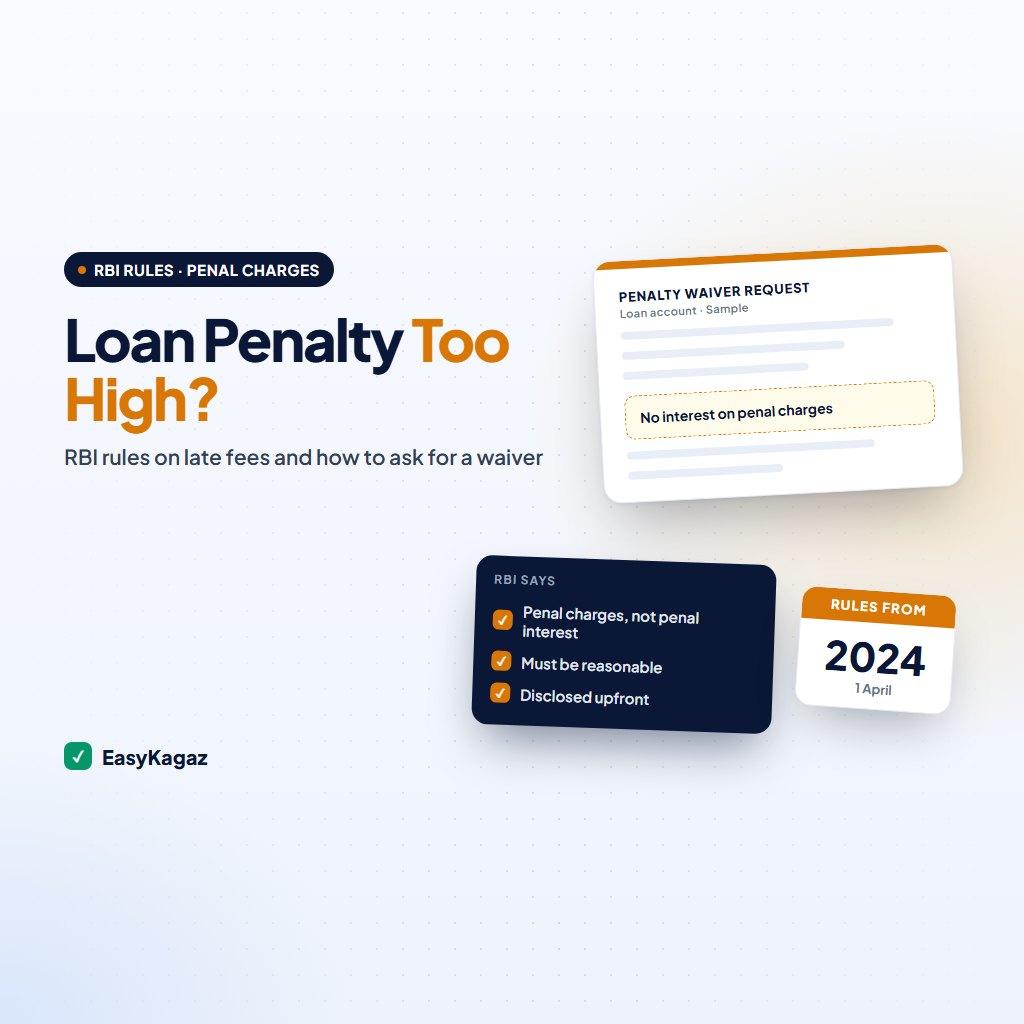
You missed one EMI, paid it a few days late — and now your loan statement shows penalty charges, bounce charges and late fees that feel far too high.
Many borrowers don't know that RBI changed the rules on loan penalties. Lenders can't charge them any way they like. This guide explains what is allowed and how to ask for a waiver.
Penalty already added? Get a penalty waiver letter drafted for your case →
RBI's Rules on Loan Penalties
RBI issued the circular "Fair Lending Practice – Penal Charges in Loan Accounts" on 18 August 2023. For new loans it applies from 1 April 2024, and existing loans were moved to the new rules by 30 June 2024.
| Rule | What it means for you |
|---|---|
| Penal charges, not penal interest | For a late EMI or breaking loan terms, the lender can levy a fixed penal charge — it can't add extra interest to your loan rate as a penalty |
| No interest on penalties | Penal charges can't be capitalised — no interest can be charged on the penalty itself |
| Reasonable and fair | Penal charges must be reasonable and match the default, not be a way to earn extra |
| Disclosed upfront | The amount and reason must be in your loan agreement / key fact statement, and you must be told when it's charged |
What it means: If your lender added interest on top of a penalty, raised your interest rate as a penalty, or charged something not disclosed in your loan documents, you have a strong reason to question it.
When Should You Ask for a Waiver?
A waiver request makes sense when:
- You missed an EMI because of a genuine reason — medical emergency, job loss, salary delay, bank technical issue
- The penalty seems too high or was not explained in your loan documents
- Interest has been charged on the penalty
- Charges were added after you already paid
- You have a good repayment record otherwise
Even when the lender followed the rules, many lenders reduce or waive penalties for genuine cases — but usually only if you ask in writing.
What to Include in a Penalty Waiver Letter
- Your details — name, loan account number, contact details
- What was charged — amount, date, and how it appears in your statement
- Why it happened — your genuine reason, briefly
- The RBI rule that applies (penal charges, not penal interest; no interest on penalties)
- Your request — full or partial waiver, and correction of the statement
- Proof — payment receipts, bank statement, medical papers, etc.
Send it to the lender's customer care email or grievance officer and keep the acknowledgement.
📝 Don't want to write it yourself? We draft it with the RBI rules that apply to your case →
If the Lender Says No
- Ask for a written reason and the breakup of charges
- Escalate to the lender's grievance officer / nodal officer
- If there's no reply within 30 days or you're not satisfied, complain to the RBI Ombudsman at cms.rbi.org.in — it's free
Tips to Avoid Penalties Next Time
- Set up auto-debit a few days after your salary date
- Keep a small buffer in the EMI account
- If you know you'll be late, tell the lender in advance in writing
- If EMIs are too high, ask for restructuring before you miss one — see EMI Restructuring Request
How EasyKagaz Helps
- ✅ Penalty waiver letter written for your case, with the RBI rules cited
- ✅ Help with RBI Ombudsman complaints if the lender doesn't respond
- ✅ Fixed fee — never a share of your loan
- ✅ Private — seen only by our team
Note: EasyKagaz is a private assistance service, not a law firm or a government body. Whether a waiver is given is the lender's decision. This article is general information, not legal advice.
📞 Not sure what applies to you? Get a free callback →
Frequently Asked Questions (FAQs)
Q: Can a bank charge penal interest on a late EMI?
A: As per RBI's rules on penal charges, a penalty for late payment can only be levied as a penal charge, not as penal interest added to the loan's interest rate.
Q: Can a bank charge interest on penalty charges?
A: No. RBI's rules say penal charges cannot be capitalised, so no further interest can be computed on them.
Q: From when do RBI's penal charges rules apply?
A: The circular was issued on 18 August 2023. It applies to new loans from 1 April 2024, and existing loans had to move to the new rules by 30 June 2024.
Q: Will the bank definitely waive my penalty?
A: Not always. A waiver is the lender's decision, but a clear written request with a genuine reason and proof gives you the best chance.
Q: Where can I complain if the bank doesn't respond?
A: To the lender's grievance officer first. If there's no reply in 30 days or you're unhappy with it, complain to the RBI Ombudsman at cms.rbi.org.in.
Q: Loan par penalty zyada lag gayi, kya karein?
A: Bank se charges ka breakup maangein aur likhit mein waiver request bhejein. RBI ke rule ke mutabik penalty par byaj nahi lag sakta. 30 din mein jawab na mile to RBI Ombudsman mein complaint kar sakte hain.
Sources: RBI — Fair Lending Practice: Penal Charges in Loan Accounts (circular) · RBI FAQs on penal charges · Business Standard — No further interest on penal charges · RBI Complaint Management System
Need Help with Loan Penalty Waiver Letter?
Don't let complex paperwork slow you down. Our experts handle everything from application to delivery.