GST New Rules from 1 November 2026: What Changes for Registration, Bank Details, Cancellation and Online Sellers

- At a Glance
- 1. New GST Registration Form (REG-01)
- 2. Bank Details Within 30 Days
- 3. Officers Told Not to Ask Unrelated Questions
- 4. Easier Changes After Registration
- 5. New Rule 14B for Online Sellers
- 6. Cancelling GST Registration — New Process
- 7. Scrap Suppliers Must Now Register
- 8. e-Invoicing for Reverse Charge and Import of Services
- 9. Coming on 1 April 2027: Suspension and Revocation
- What Should You Do Now?
- How EasyKagaz Helps
- Frequently Asked Questions (FAQs)
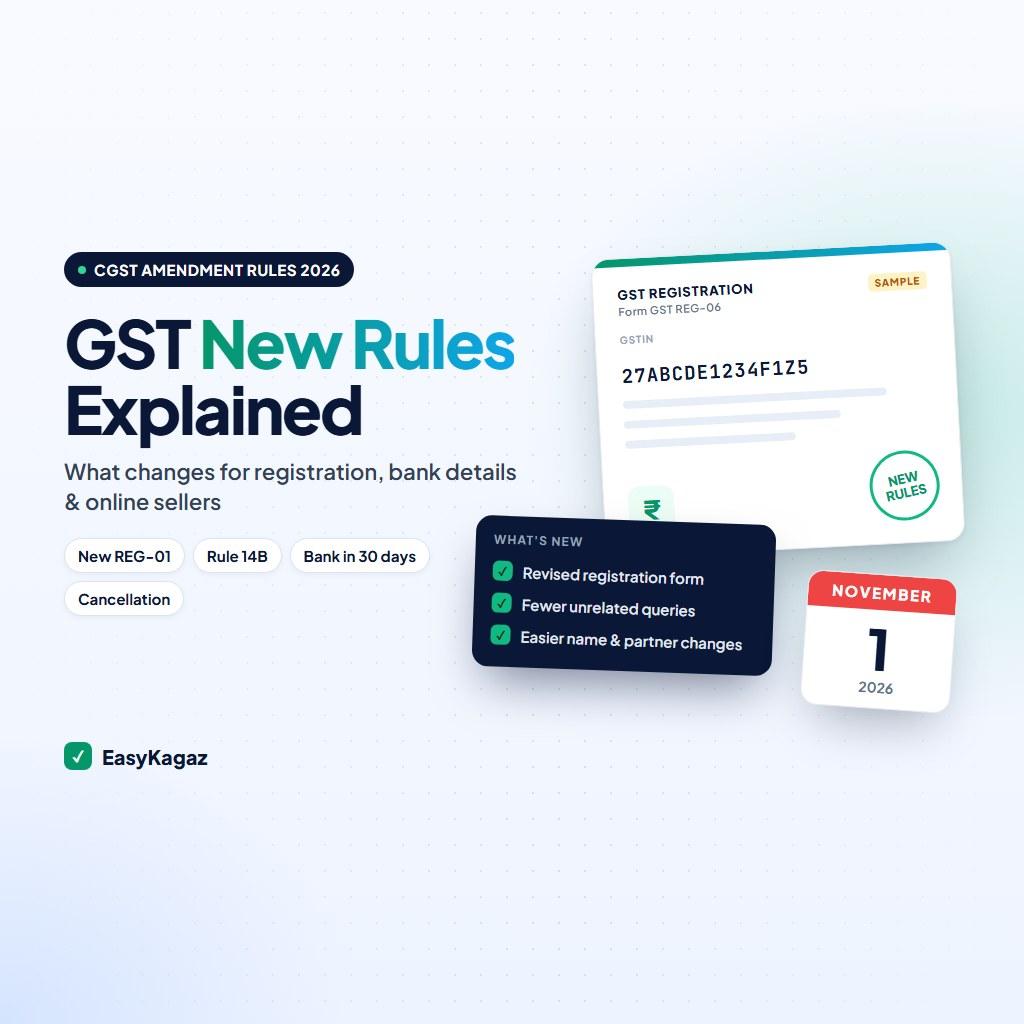
The government has notified the CGST (Amendment) Rules, 2026 through Notification No. 05/2026–Central Tax, dated 26 October 2026. Most changes apply from 1 November 2026, and some come in later — on 1 December 2026, 1 January 2027 and 1 April 2027.
If you are applying for GST registration, running a small business, or selling on Amazon, Flipkart or Meesho, these changes affect you. Here is everything in simple language.
Applying for GST now? Get GST registration done by EasyKagaz → — filed under the new rules, with documents checked first.
At a Glance
| What changed | From |
|---|---|
| New GST registration form (REG-01) with more details | 1 Nov 2026 |
| Bank account details must be added within 30 days | 1 Nov 2026 |
| Officers told not to ask unrelated questions | 26 Oct 2026 (circular) |
| Easier change of name, partners, directors, address | 1 Nov 2026 |
| New Rule 14B for online sellers using marketplace warehouses | 1 Nov 2026 |
| New process for cancelling GST on request | 1 Nov 2026 |
| Registration exemption removed for some scrap suppliers | 1 Nov 2026 |
| Revised cancellation form (REG-16) and refund form (RFD-01) | 1 Dec 2026 |
| e-Invoicing for reverse charge and import of services | 1 Jan 2027 |
| New suspension and revocation process | 1 Apr 2027 |
1. New GST Registration Form (REG-01)
The registration application now asks for more details, so that fewer applications get stuck later:
- One Person Company (OPC) is now a separate option for business type.
- A wider list of business activities — including co-working spaces, gyms, leasing of property and renting of vehicles.
- Clearer premises types for your place of business: owned, inherited, rented, consent-based, co-working or SEZ.
- Up to ten bank accounts can be added.
- For LLPs, the DIN of designated partners is required. Company and LLP numbers (CIN, LLPIN) are checked online before the ARN is generated.
What it means for you: Keep your company / LLP documents, rent agreement or consent letter, and bank details ready before you start the application.
2. Bank Details Within 30 Days
If you don't have a business bank account when you apply, you can still apply — but you must add bank details within 30 days of registration, or before filing GSTR-1 / IFF, whichever is earlier (Rule 10A).
From 1 April 2027, not adding bank details on time becomes one of the grounds on which the system can suspend your registration. So don't leave this pending.
3. Officers Told Not to Ask Unrelated Questions
A new CBIC circular (No. 257/03/2026-GST, dated 26 October 2026) tells GST officers not to raise queries on documents that are not needed. Objections like these are discouraged:
- The applicant lives in another city or state
- The applicant does not have a Udyam certificate
- The officer's own opinion on whether the premises is suitable
Processing time is unchanged: an application with Aadhaar authentication is still processed within 7 working days, and up to 30 days where physical verification is needed. If the officer raises a query (REG-03), you still reply in REG-04 within 7 working days.
📑 Got a REG-03 query? Read our guide: GST Registration Rejected or Query Raised — How to Reply
4. Easier Changes After Registration
- Changes to legal name, partners or directors are now applied automatically after online validation, and apply to all GST registrations under the same PAN.
- A change of principal place of business must be decided by the officer within a fixed time; if the officer doesn't act, it is treated as approved.
5. New Rule 14B for Online Sellers
This is a big one for e-commerce sellers.
Under the new Rule 14B, a seller who sells through an e-commerce operator (that collects TCS) can take GST registration in another state using the operator's warehouse as the place of business — with the operator's consent.
Key conditions:
- Meant for small sellers — output tax on supplies to registered buyers should not exceed ₹2.5 lakh a month
- The e-commerce operator must give consent
- Applied through the normal REG-01 form
What it means for you: If you sell on marketplaces and want to stock goods in warehouses in other states, ask your marketplace about Rule 14B before setting up a full office in that state.
6. Cancelling GST Registration — New Process
If you close your business or no longer need GST:
- Apply for cancellation within 30 days of the event (for example, closing the business). This doesn't apply to the death of a sole proprietor.
- Give details of stock and any tax payable on it.
- File all pending returns up to the cancellation date — if you filed GSTR-1 for a period, GSTR-3B for that period must also be filed.
- A revised cancellation form (REG-16) applies from 1 December 2026.
7. Scrap Suppliers Must Now Register
From 1 November 2026 (Notification No. 06/2026–Central Tax), the exemption from GST registration no longer applies to suppliers of:
- Used cooking oil
- Plastic waste and scrap
- Tyre waste and scrap
- Metal scrap
- Electrical and electronic (e-waste) scrap
If you deal in any of these, check your registration status now.
8. e-Invoicing for Reverse Charge and Import of Services
Businesses that must issue e-invoices will also need to generate them for:
- Purchases from unregistered persons under reverse charge (RCM)
- Import of services
This is mandatory from 1 January 2027. A voluntary window runs from 15 to 31 December 2026.
9. Coming on 1 April 2027: Suspension and Revocation
- If returns are not filed (for example, six months in a row for monthly filers) or bank details are not added, the system can suspend the registration with a notice (REG-31), giving 30 days to comply.
- If registration is cancelled, you can apply for revocation within 180 days, after filing pending returns and paying dues.
What Should You Do Now?
| You are… | Do this |
|---|---|
| Applying for GST | Keep company/LLP documents, address proof and bank details ready; check the business activity list |
| Already registered, no bank details added | Add them now |
| Online seller | Ask your marketplace about Rule 14B warehouse registration |
| Scrap dealer | Check if you now need to register |
| Closing a business | File pending returns and apply for cancellation within 30 days |
How EasyKagaz Helps
- ✅ GST registration under the new form, with documents checked first
- ✅ Help with officer queries (REG-03)
- ✅ Updates on WhatsApp, and status on the Track Application page
- ✅ Also starting up? See Udyam Registration and Shop Act Licence
Note: EasyKagaz is an independent assistance service, not a government website. GST registration on the official portal is free. This article is a simple summary; for your specific case, read the notification or ask a tax professional.
🧾 Ready to register? Apply for GST registration →
Frequently Asked Questions (FAQs)
Q: What are the new GST rules from 1 November 2026?
A: The CGST (Amendment) Rules, 2026 (Notification 05/2026–Central Tax) brought a new registration form, a 30-day rule for adding bank details, easier amendments, a new Rule 14B for online sellers, a new cancellation process and other changes. Some parts apply from 1 December 2026 and 1 April 2027.
Q: Has GST registration become faster?
A: The processing time is the same — 7 working days with Aadhaar authentication, and up to 30 days where physical verification is needed. But officers have been told not to raise unrelated queries, which should reduce delays.
Q: Can I get GST registration without a bank account?
A: Yes, but you must add bank details within 30 days of registration or before filing GSTR-1 / IFF, whichever is earlier.
Q: Can a GST officer reject my application because I don't have a Udyam certificate?
A: As per CBIC Circular 257/03/2026-GST, officers are discouraged from raising objections such as a missing Udyam certificate or the applicant living in another city or state.
Q: What is Rule 14B in GST?
A: Rule 14B lets small online sellers register in another state using the e-commerce operator's warehouse as the place of business, with the operator's consent, subject to conditions such as a ₹2.5 lakh monthly limit on output tax on supplies to registered buyers.
Q: Do scrap dealers need GST registration now?
A: From 1 November 2026, the registration exemption no longer applies to suppliers of used cooking oil, plastic scrap, tyre scrap, metal scrap and e-waste scrap.
Q: When is e-invoicing mandatory for reverse charge supplies?
A: From 1 January 2027 for businesses covered by e-invoicing, with a voluntary window from 15 to 31 December 2026.
Sources: India Briefing — CGST Amendment Rules 2026 · TaxGuru — GST Registration Overhaul 2026 · CAclubindia — New registration form and circular · CAclubindia — Scrap suppliers (Notification 06/2026) · GSTN advisory on e-invoicing for RCM and import of services · CBIC
Need Help with GST Registration?
Don't let complex paperwork slow you down. Our experts handle everything from application to delivery.